
East Asia typhoon recovery: recheck Vietnam cargo schedules in week 39
East Asian port and vessel flows are recovering from typhoon disruption, but the carrier outlook and Vietnam's marine forecast still justify shipment-level schedule checks this week.
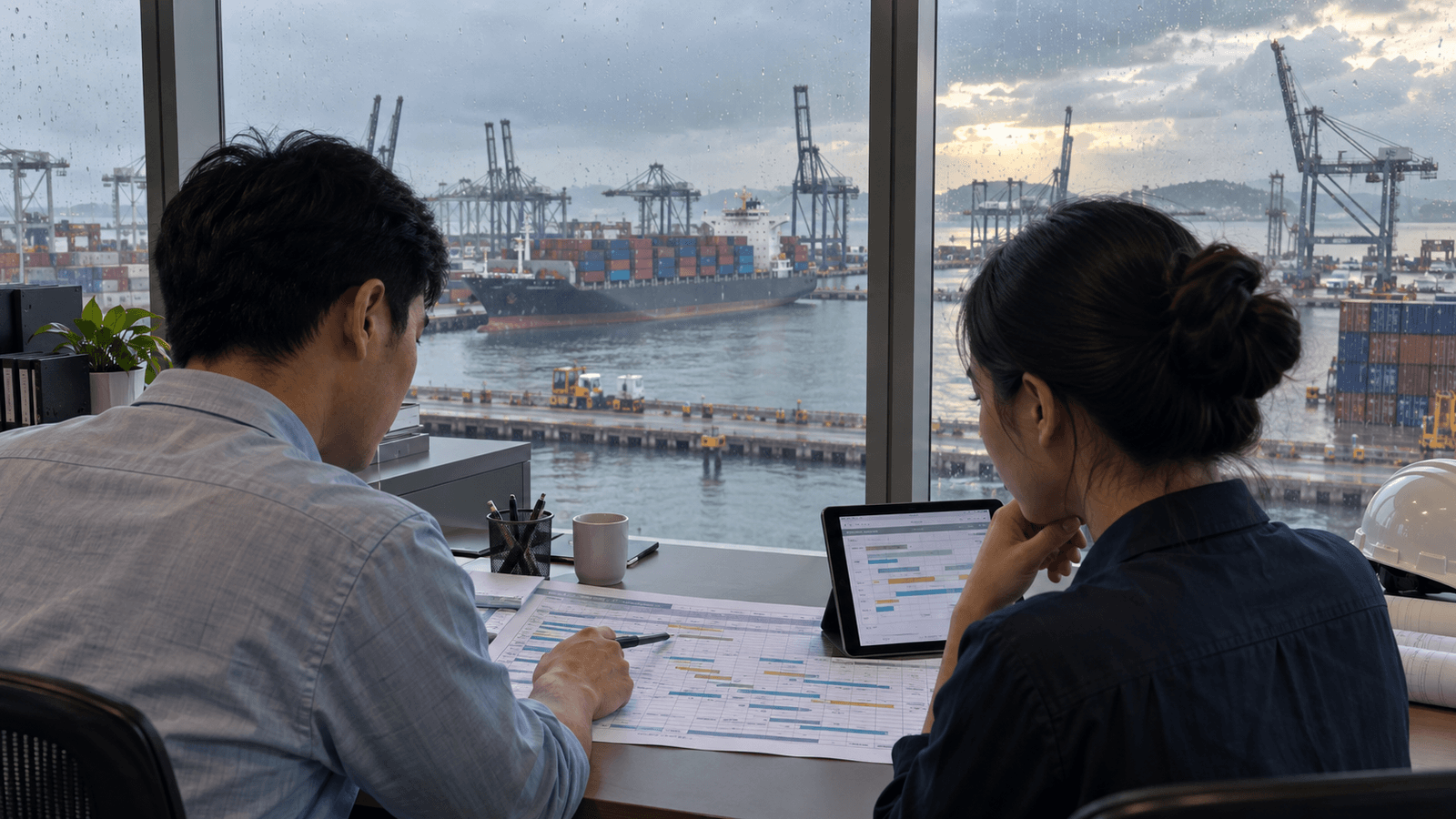
East Asian port performance and vessel flows are gradually improving after recent typhoon disruption, according to Maersk's 18 September update. The same notice says operating conditions remain challenging and that the carrier is monitoring the possibility of another typhoon developing during week 39, from 21 to 27 September.
For Vietnam importers and exporters, this is a reason to refresh the schedule for each shipment, not a reason to assume that every port or service will be delayed. Vietnam's official marine forecast for 21 September does not announce a blanket port closure. It does, however, forecast thunderstorms and force 7–8 gusts in several sea areas, with waves of 1.5–2.5 metres in the northern South China Sea and potentially above 2.5 metres during thunderstorms.
What is confirmed now
Maersk reported on 4 September that a sequence of severe typhoons had caused flooding, congestion and vessel-operation delays across East Asia. Its 18 September follow-up says recovery measures are improving port performance and vessel flows, but that conditions are still challenging. The carrier is working with terminal partners and says it may use alternative routing and other logistics options for affected customers.
The possible week-39 typhoon is a monitoring signal, not a confirmed Vietnam landfall. The Hong Kong Observatory's forecast available on 21 September places Tropical Cyclone Dujuan south of Japan and expects a broad trough to bring unsettled weather from seas east of the Philippines to the central South China Sea in the middle and latter parts of the week. These facts do not prove that a particular Vietnam feeder, transshipment hub or mainline sailing will be disrupted.
Vietnam's National Center for Hydro-Meteorological Forecasting gives shipment planners a separate local reference point. Its 21 September marine forecast covers thunderstorms, gust risk and wave conditions along the Vietnamese coast and across the South China Sea. It should be checked again close to cargo handover because marine forecasts and carrier schedules can change.
Six checks for Vietnam cargo this week
### 1. Map the real route
Record the origin terminal, feeder, transshipment hub, mainline vessel, voyage and destination terminal. A regional weather advisory has different consequences for a direct call and for a shipment connecting through one or more East Asian hubs.
### 2. Refresh every cut-off
Reconfirm empty-container release, depot, cargo cut-off, documentation cut-off, VGM cut-off and gate appointment. Use the current booking confirmation or a written carrier update rather than an older schedule screenshot.
### 3. Check the connection, not only the first vessel
A feeder may sail as planned while the onward vessel changes. Ask whether the planned connection is still protected and what happens if the feeder arrives after the transshipment cut-off.
### 4. Protect sensitive cargo
For reefer, moisture-sensitive or high-value cargo, confirm power arrangements, temperature instructions, packaging, insurance conditions and escalation contacts. Do not infer extra free time or carrier liability from a weather advisory.
### 5. Set a decision trigger
Name the schedule event that will trigger action: a rolled booking, revised ETA, changed port call, missed connection or official terminal restriction. Assign a person and a deadline for deciding whether to wait, reroute or compare another mode.
### 6. Compare written alternatives
If timing is critical, compare alternative sailings, routings, air freight or inland options using current written quotations. Include all-in cost, cut-offs, connection risk and realistic delivery milestones; do not compare an old ocean quote with a new expedited option.
Concrete impact on Vietnam trade and freight
Vietnam cargo can be affected even when the origin port remains open because vessels and containers circulate through a regional network. A delayed previous port call can shift a Vietnam ETA, compress a feeder connection or change equipment availability. These are possible network effects, not confirmed outcomes for every shipment.
The practical response is shipment-level visibility: refresh the schedule, preserve documentation readiness, protect sensitive cargo and agree on an escalation point before cargo handover. This can reduce avoidable surprises, but it cannot guarantee space, port acceptance, an on-time connection or a delivery date.
Confidence is high for the content of the two official Maersk notices and the official meteorological bulletins as observed on 21 September. Confidence is medium for any individual Vietnam shipment until its carrier and relevant terminal confirm the current cut-offs, route and milestones in writing. This is operational information, not a weather warning or binding transport offer.
Turn this guidance into a shipment check
Use the relevant commercial route or Vietnam handling service below, then send the real shipment details for a current option. Rates, space and transit plans are checked against the live requirement.
Official and editorial sources
- Maersk, East Asia typhoon season: Update 2, 18 September 2026
- Maersk, East Asia typhoon season impacting logistics, 4 September 2026
- Vietnam National Center for Hydro-Meteorological Forecasting, marine weather forecast for 21 September 2026
- Hong Kong Observatory, nine-day weather forecast accessed 21 September 2026
Need an updated freight quote?
Send John your cargo details and preferred route. He will help check the best practical option.
Get a Freight Quote