
Vietnam logistics-centre grades: seven checks before the 2027 rules
Circular 71/2026 takes effect on 8 January 2027. Operators will self-declare grades and capacity, but the declaration is not a customs licence or service guarantee.
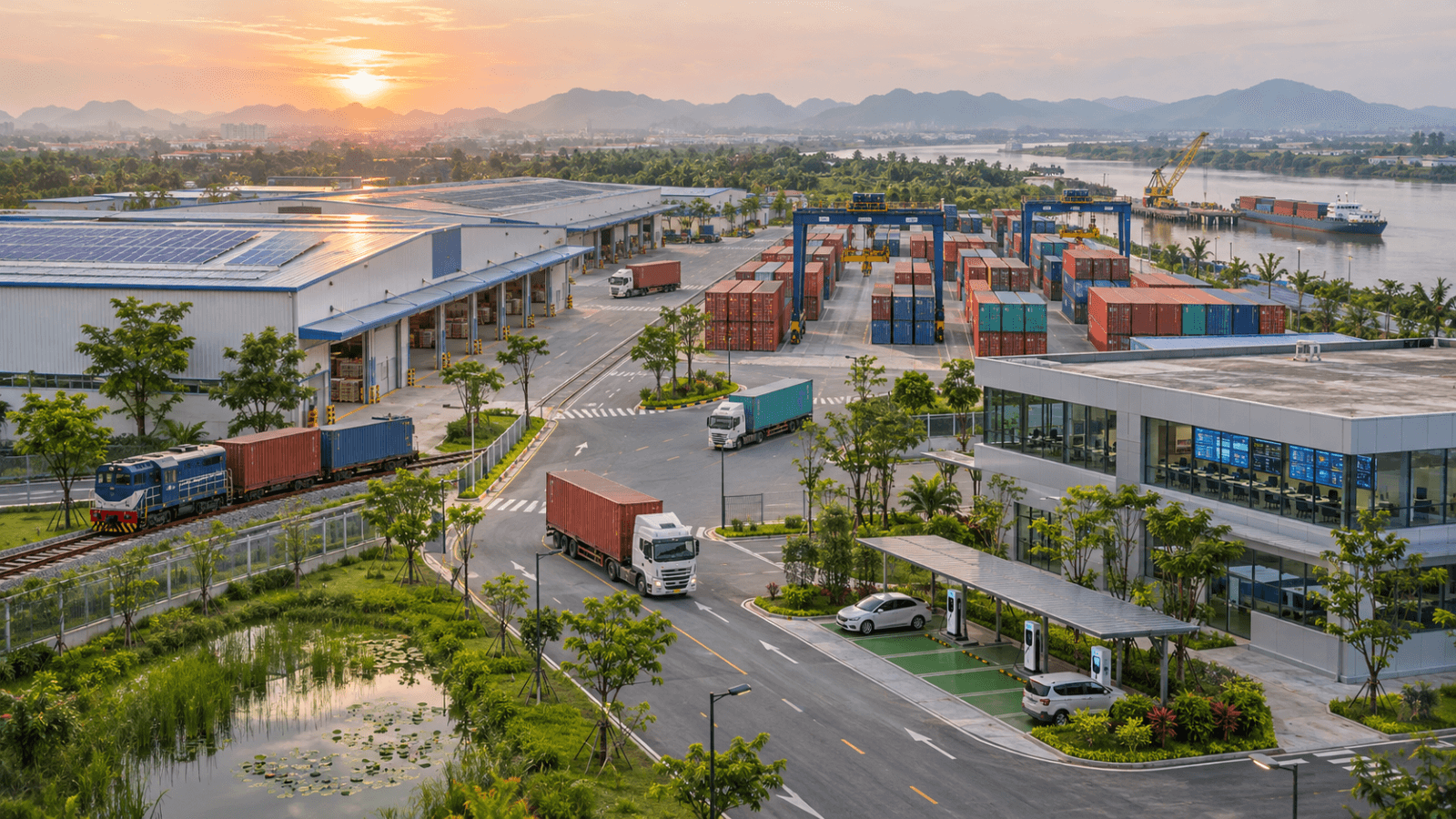
Vietnam’s Ministry of Industry and Trade issued Circular 71/2026/TT-BCT on 19 November 2026. It takes effect on 8 January 2027 and creates common criteria for classifying and grading logistics centres operating in Vietnam.
The issue date and effective date are different. The circular applies to investors and operators of logistics centres and to the authorities involved in their development and management. It does not create a new cargo clearance procedure for every importer or exporter.
What the three grades mean
Grade I is the international/national tier. It requires direct connection to at least two transport modes and to an expressway network or major national highway. Its scale threshold is at least 3 million tonnes a year, 200,000 TEU a year, or 35 million orders a year; it also requires at least 20 hectares and parking for 200 containers.
Grade II is the regional tier. Its capacity range is 1 million to under 3 million tonnes, 70,000 to under 200,000 TEU, or 10 million to under 35 million orders a year, with an area from 10 to under 20 hectares. Grade III is the provincial tier, below the Grade II capacity floors and with 3 to under 10 hectares.
The tiers also test technology, connectivity, service scope and green infrastructure. A Grade I warehouse-management system must connect electronically with external parties such as ports, customs, carriers, cargo owners or e-commerce platforms. Grade I also requires 24-hour backup power for specified specialised storage, security, safety and last-mile coordination systems, plus backup telecom connections from at least two independent providers.
The circular separately recognises five centre types: transport-mode centres, sector-specific centres, centres in export-processing/free-trade/non-tariff zones, border-gate centres and e-commerce centres.
Seven checks before relying on a published grade
1. Confirm the legal identity and effective date
Record the operator, facility address and the entity making the declaration. Circular 71 was issued on 19 November 2026 and takes effect on 8 January 2027. A facility’s marketing description before that date is not automatically a declaration under the circular.
2. Match capacity to one unit
Check whether the facility declares tonnes, TEU or orders per year, and ask for the period and measurement method. Do not add or convert the alternatives without a documented basis. A Grade I claim based on 200,000 TEU does not by itself prove a particular commodity’s handling capacity.
3. Verify the physical connection, not only proximity
For Grade I, the text requires direct connection to at least two transport modes and to an expressway or major national highway. A nearby port or rail line is not enough evidence by itself. Shipment planning still needs the actual gate, road, rail, barge or terminal link and its operating constraints.
4. Test systems against the cargo workflow
Ask which external parties are electronically connected, which messages are exchanged and what happens during an outage. A stated WMS level or digitalisation percentage does not prove that a shipper’s booking, customs status, inventory or delivery-order data is integrated.
5. Separate grade from specialised permission
Article 4 expressly says self-declared type and grade do not replace a licence, recognition decision, certificate or confirmation required by specialised law. A grade therefore does not prove customs supervision status, bonded operation, food or dangerous-goods eligibility, quarantine capability or any other cargo-specific authorisation.
6. Capture the public record and update date
Before the national commercial-infrastructure database is officially operating, the operator must publish its information on its official website and, within five working days after publication or update, notify the relevant local authority with the link and a copy. Once the database operates, information must be declared and updated there. Keep the URL, capture date and revision date in the supplier file.
7. Keep service performance in the contract
The circular’s grade is not a promise of space, dwell time, truck turn time, customs release, cut-off compliance, security outcome or price. Put shipment-level service levels, exclusions, data interfaces, outage procedures and liability in the commercial agreement.
Concrete impact on Vietnam freight and trade
Operators now have a common structure for presenting annual capacity, transport links, service scope, digital systems, resilience and sustainability. Importers, exporters and forwarders can use the published declaration as a supplier-screening input when selecting consolidation, warehousing, border or multimodal facilities.
The useful control is evidence-based comparison, not grade-only procurement. A higher tier can signal broader scale or connectivity, but it does not authorise a specific cargo, guarantee customs processing or replace live checks on slot availability, equipment, operating hours and route access.
Confidence is high on the issue and effective dates, thresholds, self-declaration model, five-day notification rule and specialised-permission limitation because they appear in the official record and signed text. Facility-level confidence remains medium until the operator publishes evidence and the relevant authority can verify it. This is operational editorial guidance, not legal advice, a customs decision or a facility-performance guarantee.
Turn this guidance into a shipment check
Use the relevant commercial route or Vietnam handling service below, then send the real shipment details for a current option. Rates, space and transit plans are checked against the live requirement.
Official and editorial sources
Need an updated freight quote?
Send John your cargo details and preferred route. He will help check the best practical option.
Get a Freight Quote