
FCL vs LCL Shipping from Vietnam: Which Option Should You Choose?
Compare cargo volume, total charges, handling risk and timing to choose between FCL and LCL shipping from Vietnam.
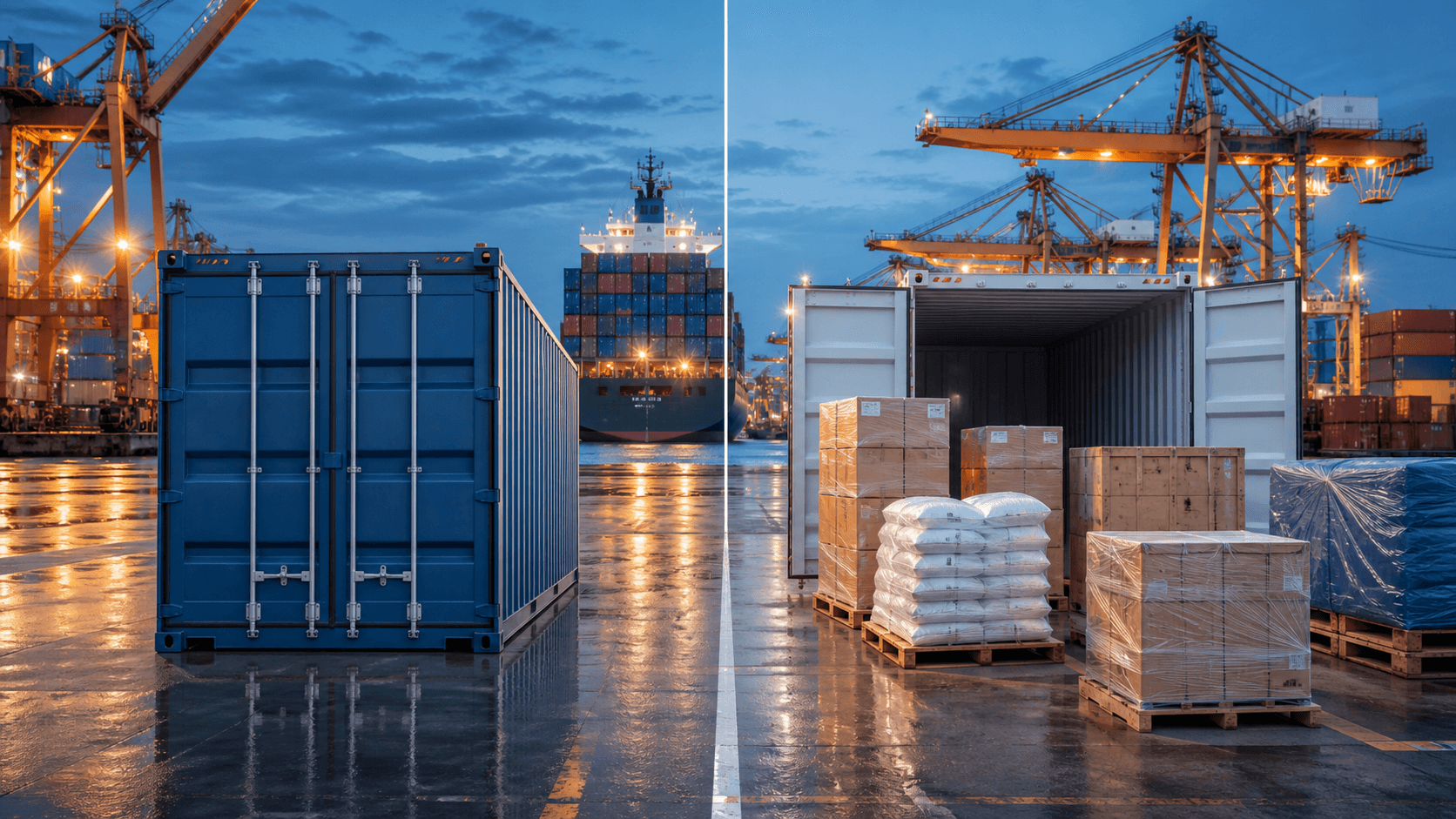
FCL and LCL are two ways to move cargo by sea from Vietnam. FCL, or Full Container Load, gives one shipper the use of a container. LCL, or Less than Container Load, combines several shippers' cargo in one container. The better option is not decided by volume alone: total origin and destination charges, cargo characteristics, handling risk, schedule and delivery scope all matter.
For a shipment-specific comparison, start with our Ocean Freight service and provide the pickup point, destination, commodity, package dimensions, gross weight, total CBM, ready date and Incoterm.
16 September 2026 checkpoint: one LCL Europe surcharge changes tomorrow
Maersk Logistics & Services announced on 16 September that its LCL Peak Season Surcharge (PSS) for Far East Asia to North Europe and Mediterranean Europe (E1W/E2W) will stop applying from a Price Calculation Date of **17 September 2026**. Vietnam is explicitly included in the Far East Asia origin list.
This is useful timing information for smaller Vietnam-to-Europe shipments, but it is **not** a universal market-rate reduction. It applies to the named Maersk LCL product and effective-date basis; another carrier, consolidator, routing, local charge or quote validity may differ. If you are comparing LCL with FCL for Europe, ask for a fresh all-in quotation rather than subtracting a PSS from an older quote yourself.
For Mediterranean cargo, you can also review Vietnam–Italy shipping and request a current shipment check with your cargo-ready date and destination.
What changes when you choose FCL?
With FCL, the container is assigned to one shipper. The cargo may be loaded at a factory or warehouse, or delivered to a container yard depending on the booking and service scope. Common equipment includes 20-foot and 40-foot dry containers, but equipment suitability must be checked for the actual cargo.
FCL can be attractive when the shipment uses a meaningful share of a container, when individual packages are difficult to consolidate, or when fewer handling stages are preferred. It does not mean the container is guaranteed to sail faster, and it does not remove port, customs, trucking, documentation or destination charges.
What changes when you choose LCL?
With LCL, cargo is delivered to a consolidation warehouse, grouped with other shipments, loaded into a shared container and separated again at destination. Charges are commonly based on chargeable weight or measurement, subject to minimums and local tariffs.
LCL can suit smaller shipments that do not justify a full container. However, the quote should be checked beyond the ocean-freight line. Consolidation, deconsolidation, warehouse handling, documentation, pickup and destination fees can materially affect the total.
Compare these six decision points
- **Volume and weight:** Ask for both FCL and LCL totals when cargo is approaching a practical break-even range. There is no universal CBM threshold because rates, density and local charges vary by route and date.
- **Total landed logistics cost:** Compare every known origin, ocean and destination charge—not only the base freight.
- **Handling risk:** LCL normally involves more warehouse and cargo-handling stages. Packaging should be suitable for shared-container movement and stacking conditions.
- **Timing:** LCL needs consolidation before departure and deconsolidation after arrival. Actual schedules and cut-offs must be confirmed for the booking.
- **Cargo compatibility:** Dangerous goods, controlled goods, fragile pieces, liquids, food products and oversized cargo may face special acceptance or segregation rules.
- **Delivery scope:** Include pickup, export formalities, destination clearance and final delivery in the same comparison where possible.
A simple working rule
Choose LCL for a smaller, well-packed shipment when its complete door-to-door cost is lower and the extra handling stages are acceptable. Choose FCL when the all-in difference becomes small, the cargo fills enough of the container, or control and reduced handling matter more than the lowest base rate.
The final choice should come from two comparable quotations built on the same route, cargo details, Incoterm and delivery scope. A low LCL ocean rate is not automatically the cheapest complete solution; an FCL rate is not automatically better simply because the cargo is bulky.
Route and service checks from Vietnam
Local planning can change the comparison. Use Customs Clearance to prepare the export or import file and Trucking to compare pickup, container positioning or delivery scope.
For lane-specific planning, review our guides for Vietnam–Italy shipping, Vietnam–Indonesia shipping and Vietnam–Taiwan shipping. Each lane has different sailing options, local charges, cut-offs and delivery requirements.
Details needed for an accurate comparison
- Pickup address or Vietnamese load port.
- Destination port and final delivery postcode.
- Commodity and HS code if available.
- Number and type of packages, dimensions, gross weight and total CBM.
- Stackability, dangerous-goods status and special handling needs.
- Cargo-ready date and preferred schedule.
- Incoterm and required service scope.
Do not split these details across two incomplete requests. Ask the forwarder to price FCL and LCL against the same information, list exclusions and state quote validity. Request a freight quote or contact Booking by John to compare the two options for your shipment.
Turn this guidance into a shipment check
Use the relevant commercial route or Vietnam handling service below, then send the real shipment details for a current option. Rates, space and transit plans are checked against the live requirement.
Need an updated freight quote?
Send John your cargo details and preferred route. He will help check the best practical option.
Get a Freight Quote